


The Pyramids of Giza have never been more alive. Earlier this month, the Grand Egyptian Museum finally unveiled its full collections to the world with a glittering inauguration attended by royalty and world leaders, and now, the Giza Plateau has been transformed into an open-air gallery thanks to the arrival of the fifth edition of Forever is Now.
Running until 6 December, Forever is Now will see the Giza Plateau taken over by 10 large-scale contemporary art installations. Organised by cultural platform Art D’Egypte, the exhibition brings fresh artworks, artists and themes each year to the 4,500-year-old site. This year, artists were invited to explore the concept of immortality – a central belief in ancient Egypt, where kings built tombs for the afterlife. The goal is to spark a dialogue between the past, cultural heritage and contemporary art.
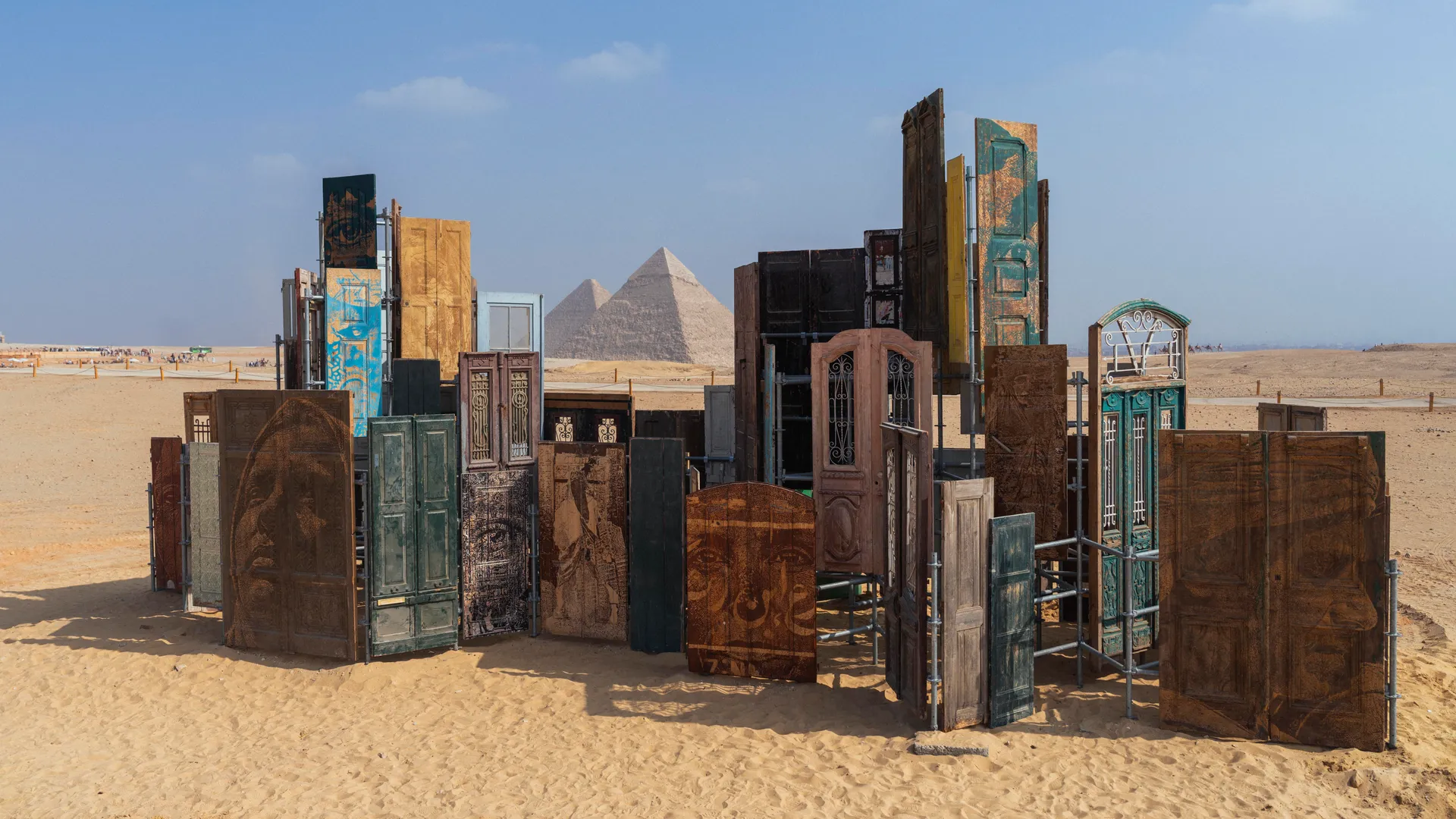
“All of the artworks have a connection with ancient Egypt,” says founder Nadine Abdel Ghaffar, standing in front of Alexandre Farto’s Doors of Cairo. “What stands out this year is that we have several artists who are very important internationally.”
Among them are 92-year-old Nobel Peace Prize nominee Michelangelo Pistoletto, a key figure in the Italian Arte Povera movement, which translates as ‘poor art’ and emphasises the use of humble, unconventional materials. Portuguese artist Farto, also known as Vhils, is celebrated for his unique technique of carving portraits into walls and urban surfaces.
For Doors of Cairo, Vhils collected discarded doorways from Cairo’s Garbage City, where generations of Zabbaleen families have made a living by sorting the city’s waste. Of the 65 doors, around 40 were engraved with the faces of everyday Cairenes, as well as Hieroglyphics and Arabic calligraphy. “It’s an homage to Cairo today,” Vhils says. “My objective was to bring the people of Cairo and the everyday life of Cairo here to the Pyramids.”
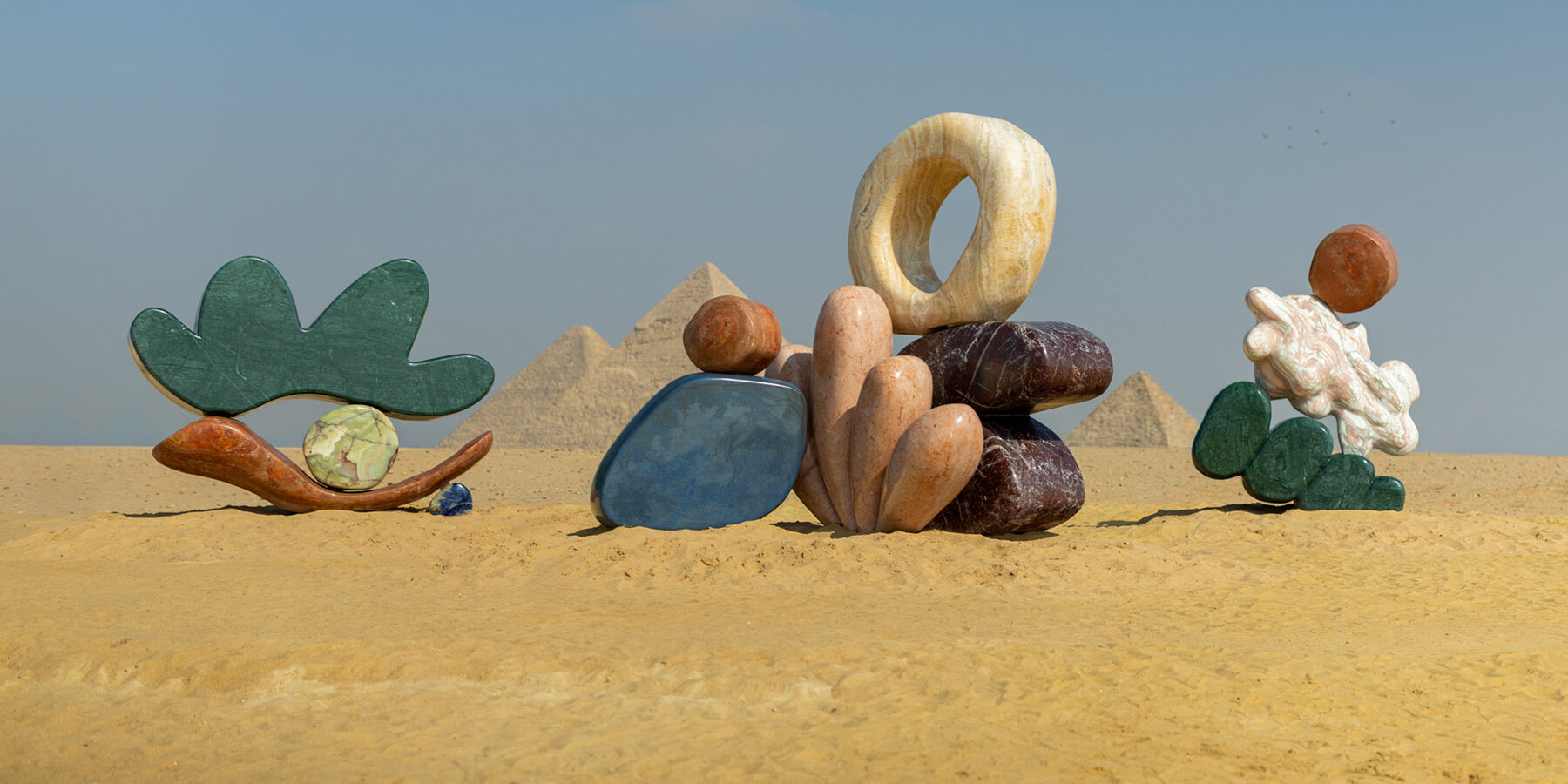
Alex Proba’s ‘Echoes of the Infinite’ Courtesy Art D’Egypte
US-based artist Alex Proba teamed up with Netherlands-based natural stone and design brand SolidNature for Echoes of the Infinite, a three-sculpture installation made from marble, onyx, travertine and quartzite. Known for brightly coloured art pools, murals and public sculptures, Proba opted for slightly more subdued shades here, though the shapes remain playfully dynamic. The forms incorporate motifs of the Eye of Horus, the scarab, the blue lotus and the Milky Way.
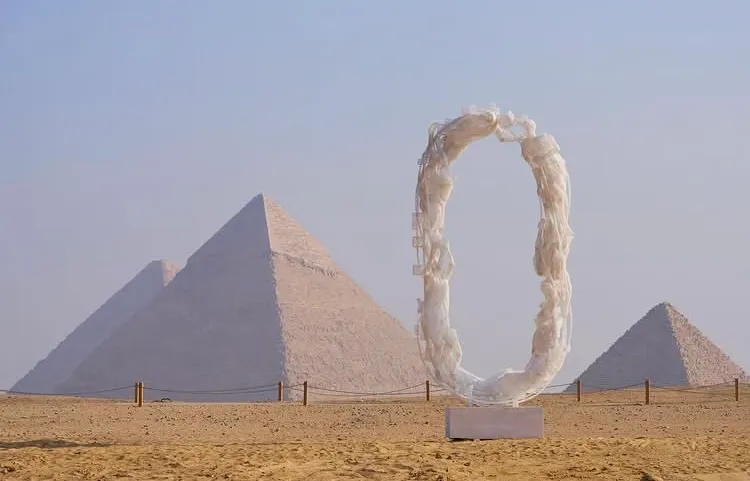
Recycle Group’s ‘Null’ Courtesy Art D’Egypte
Null, a ring of human figures crafted from white plastic mesh, is by Paris-based Recycle Group. The Russian duo behind the group, Andrey Blokhin and Georgy Kuznetsov, used recycled materials to comment on contemporary culture. The frozen figures are caught in the mesh, symbolising being stuck in the virtual world.
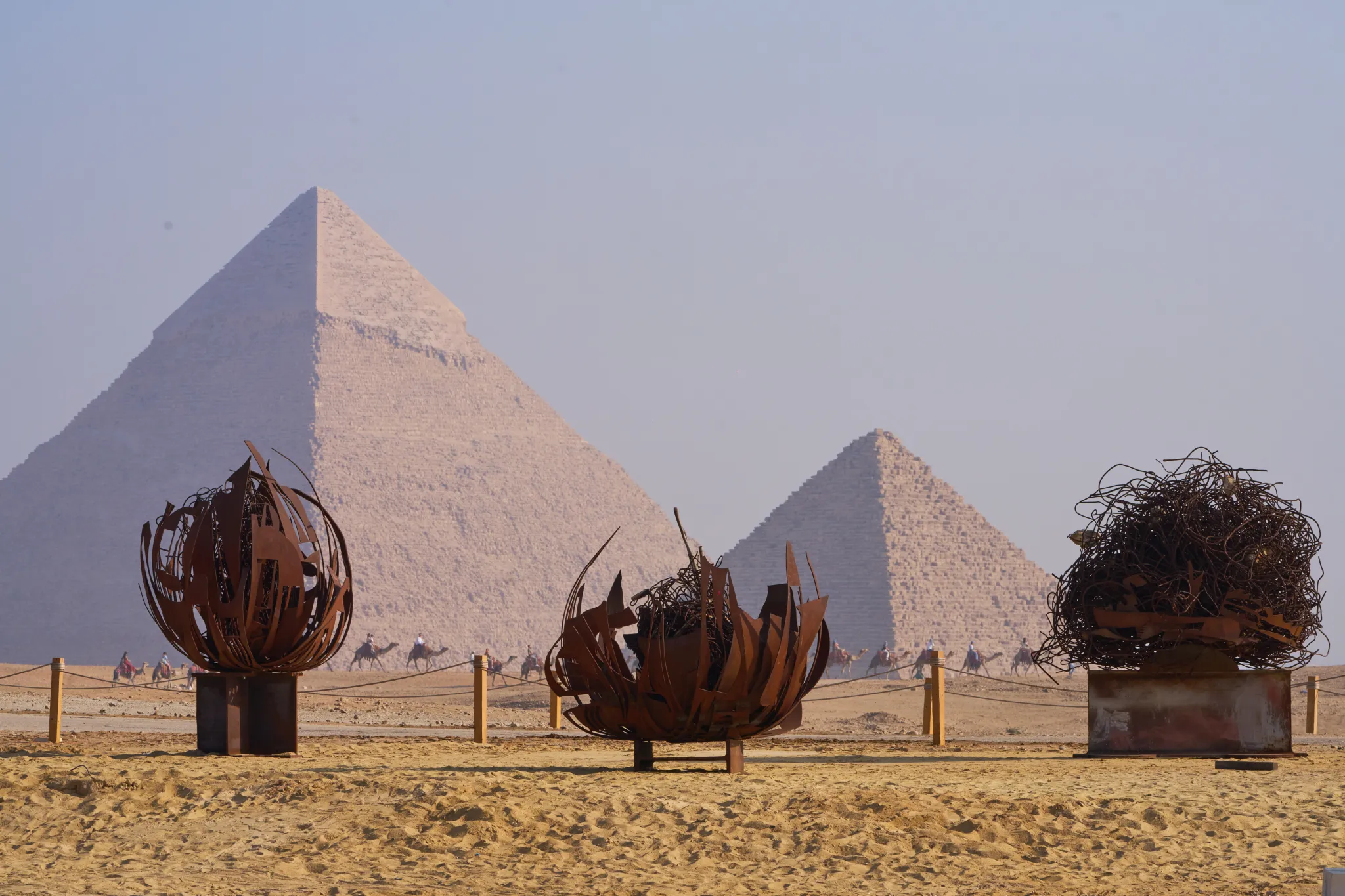
Nadim Karam’s ‘Desert Flowers’ Courtesy Art D’Egypte
Lebanese artist Nadim Karam’s Desert Flowers transforms steel debris into three sculptures symbolising a lotus flower in bloom. “The lotus flower is very important in ancient Egyptian culture,” Karam says. “To transform something destructive to something creative, especially to a flower, is very symbolic.” His previous works include On Parade at Desert X in Al-Ula and The Gesture, a temporary sculpture created from scrap metal from the 2020 Beirut port blast.
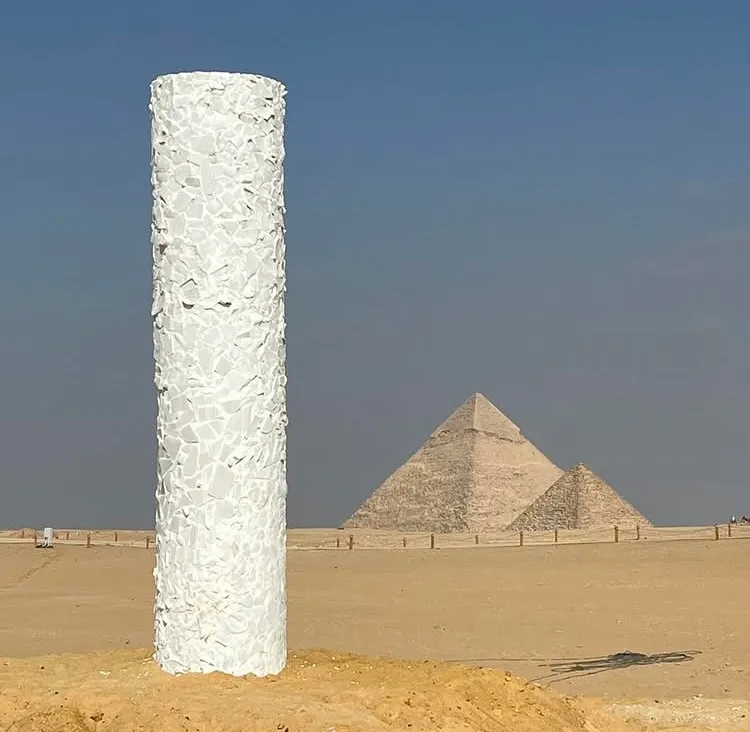
King Houdekpinkou’s ‘White Totem of Light’ Courtesy Art D’Egypte
Franco-Beninese ceramic artist King Houdekpinkou came to Cairo to create his two-metre-high White Totem of Light at the Sheeni factory, but it exploded in the kiln. Viewing it as an “opportunity to create something even more interesting,” he covered the totem with the broken shards. “I want this piece to be a ray of light for anyone searching for answers,” he says. “And this ray of light is leading you to the 4,500-plus years of history behind it with the Pyramids.”
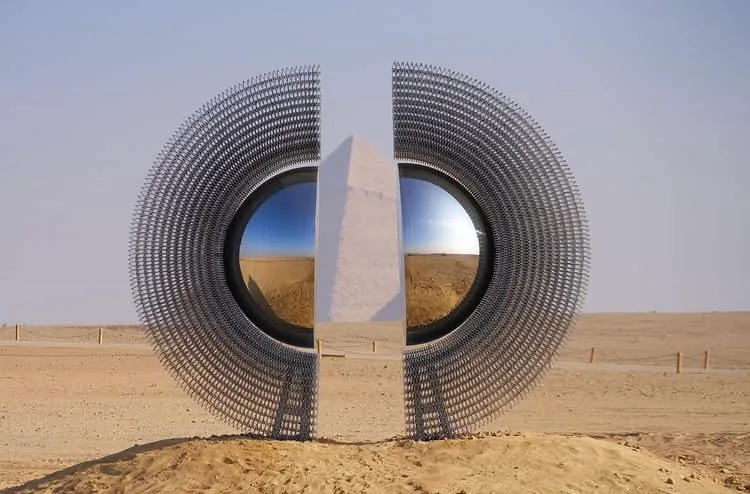
Mert Ege Köse’s ‘The Shen’ Courtesy Art D’Egypte
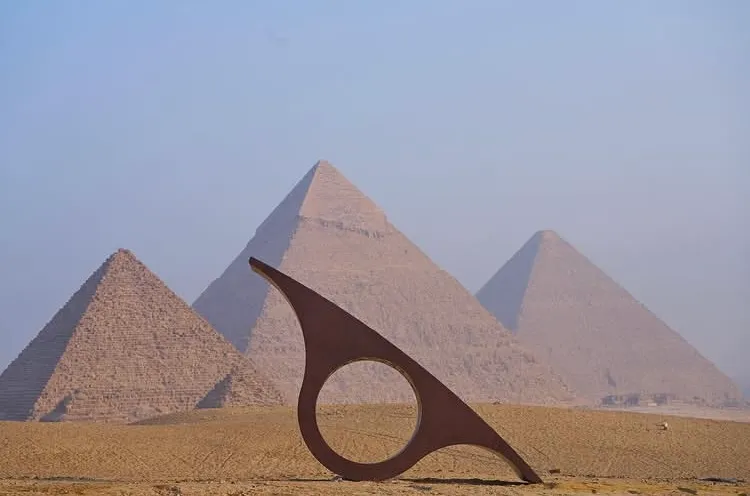
In The Shen, Turkish sculptor Mert Ege Köse created a split circular form of aluminium and stainless steel, framing the Great Pyramid. The shape evokes the ancient Egyptian symbol representing infinity and divine protection.
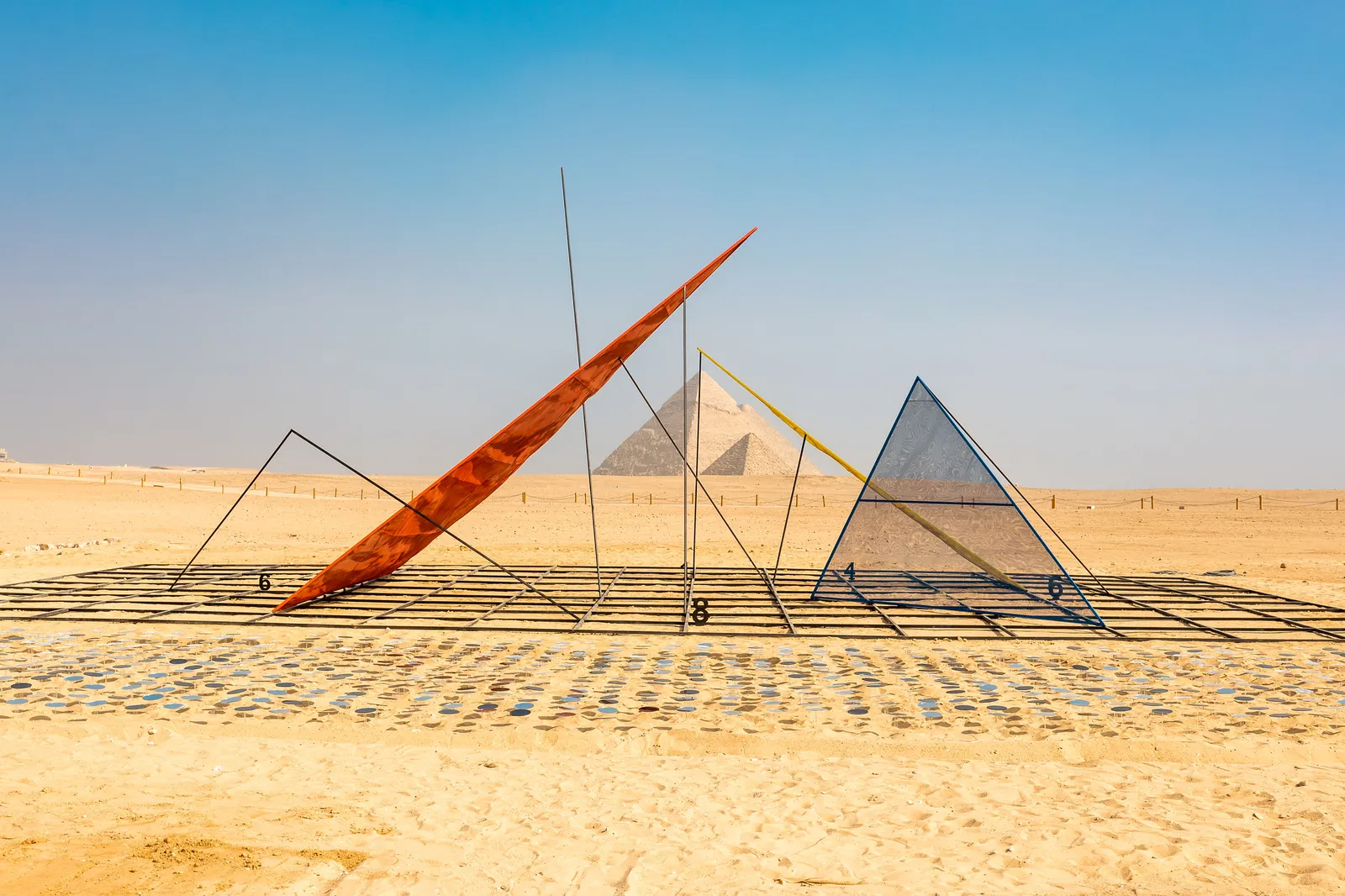
J.Park’s ‘Code of the Eternal’ Courtesy Art D’Egypte
Korean artist J.Park’s Code of the Eternal uses a formula to transform phone numbers and identities into geometric shapes. In front of the pyramid structures, 1,000 stainless steel mirror dots represent Morse code for a message imagined between ancient Korea’s founder and a Pharaoh. “Just like in the Pyramids and ancient Egyptian art, every artwork has a secret message in it, and I also wanted to deliver my message indirectly,” Park says.
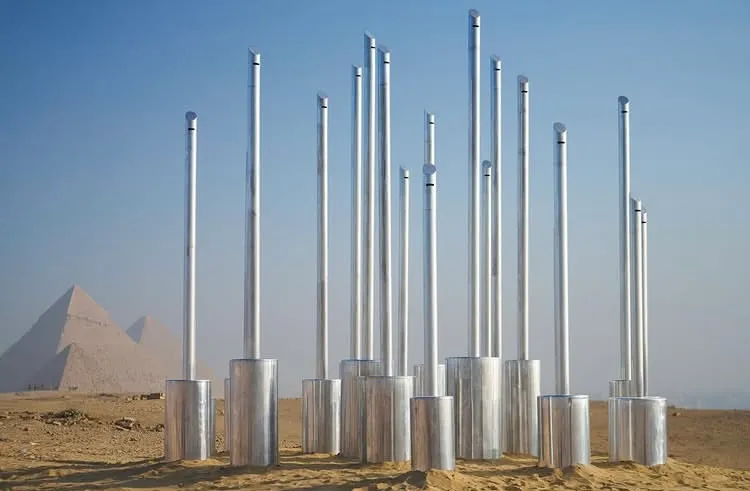
‘The Wind’ by Ana Ferrari Courtesy Art D’Egypte
The Wind, an installation by Brazilian artist Ana Ferrari, features 21 polished aluminium flutes that emit a gentle, meditative sound when stirred by the wind. “It’s an invitation to feel the energy of nature,” she says, comparing it to the acoustic chambers of the Pyramids.
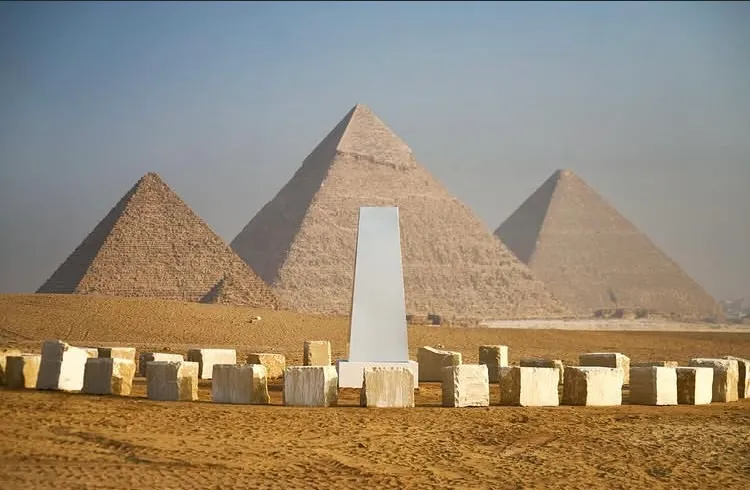
Michelangelo Pistoletto’s ‘The Third Paradise’ Courtesy Art D’Egypte
The last two artworks, which sit closest to the Pyramids, serve as the exhibition’s finale. Pistoletto’s The Third Paradise has been exhibited all over the world, including the Louvre in Paris and the UN headquarters in Geneva. It reinterprets the infinity symbol with three circles to represent a harmonious balance between nature, technology and humanity. On the Giza plateau, the symbol is built from limestone blocks, with an obelisk at its centre.
Salha Elmasry’s ‘Ma’at’ Courtesy Art D’Egypte
And finally, next to Pistoletto’s work, is Egyptian artist Salha Elmasry’s Ma’at, referring to the ancient Egyptian concept of truth, justice and cosmic order. “This is to send a message to the whole world, that ancient Egyptian civilisation didn’t just leave us with architectural monuments, such as the Pyramids with their greatness and majesty, but they ingrained in us human values,” she explains.
Forever is Now 5 is open to the public at the Pyramids of Giza until December 6