


SYNOPSIS
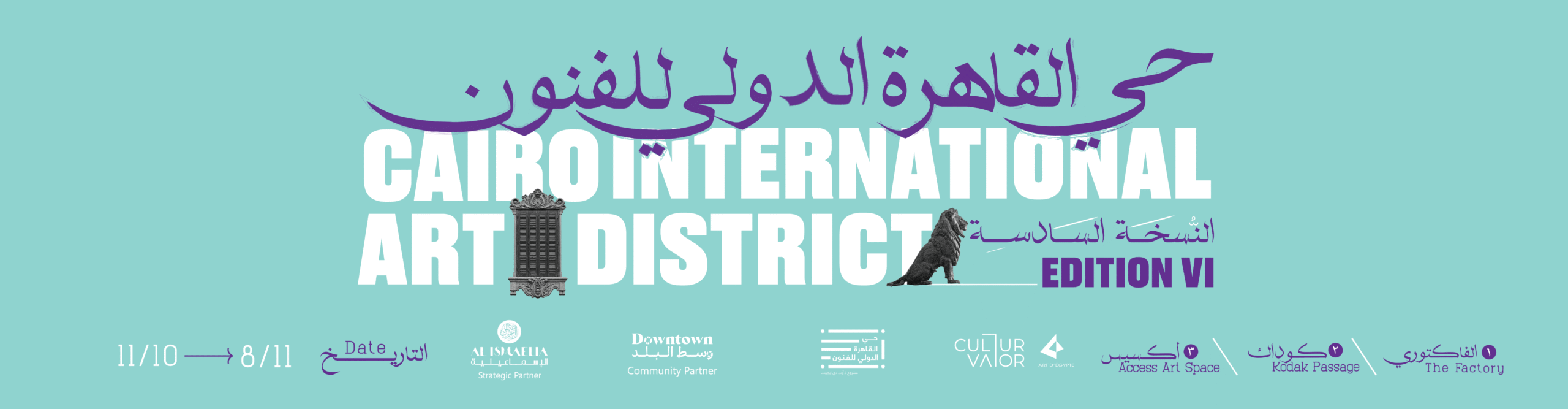
The Cairo International Art District (CIAD) is Art D’Égypte’s flagship intervention into the streets, buildings, and public memory of Downtown Cairo, a multidisciplinary platform that turns the district’s historic fabric into a living stage for contemporary practice. Now in its sixth edition, CIAD gathers site-specific installations, urban interventions, and a citywide art walk across three central venues: The Factory, Access Art Space, and Kodak Passage.
This edition marks six consecutive years of partnership between Art D’Égypte and Al Ismaelia for Real Estate Investment, sponsored by Tradeline, a collaboration rooted in the preservation, revitalization, and cultural activation of Downtown Cairo. Over six years, this alliance has fostered an ongoing dialogue between contemporary art, the city’s architectural heritage, and its evolving public spaces, reinforcing Downtown as a living cultural destination and a space for creative exchange.
Titled Alive Archive, the sixth edition takes as its premise that Downtown Cairo is not a fixed backdrop but a living archive, one that stores its history not primarily in monuments or official records, but in traces: a worn stair, a café chair reshaped by years of use, layers of paint and peeling posters, a path walked daily until it becomes the street’s own rhythm. The exhibition treats these overlooked marks as the material of collective memory, proposing that Downtown’s identity is built less by exceptional moments than by the slow accumulation of ordinary ones.
CIAD’6 develops this idea across several distinct bodies of work. The World Appears in Fragments explores geography not as a fixed physical space, but as something continuously shaped by memory, experience, perception, desire, and absence, beginning from the premise that a place does not reach us as a complete reality but passes through consciousness, where it is altered, fragmented, and reassembled before emerging again as an image, a material, or a trace. Between the world and its representation exists an invisible space where personal memory intersects with intuition and imagination, creating individual geographies that cannot be contained by fixed maps or clear boundaries. Here, each artwork becomes a subjective map, not of a particular place, but of the traces a place leaves within us.
Date & Time:
October 11, 2026
-
November 8, 2026